
What is Forging? A Comprehensive Guide to the Forging Process and the Advantages of Forged Components in Industry
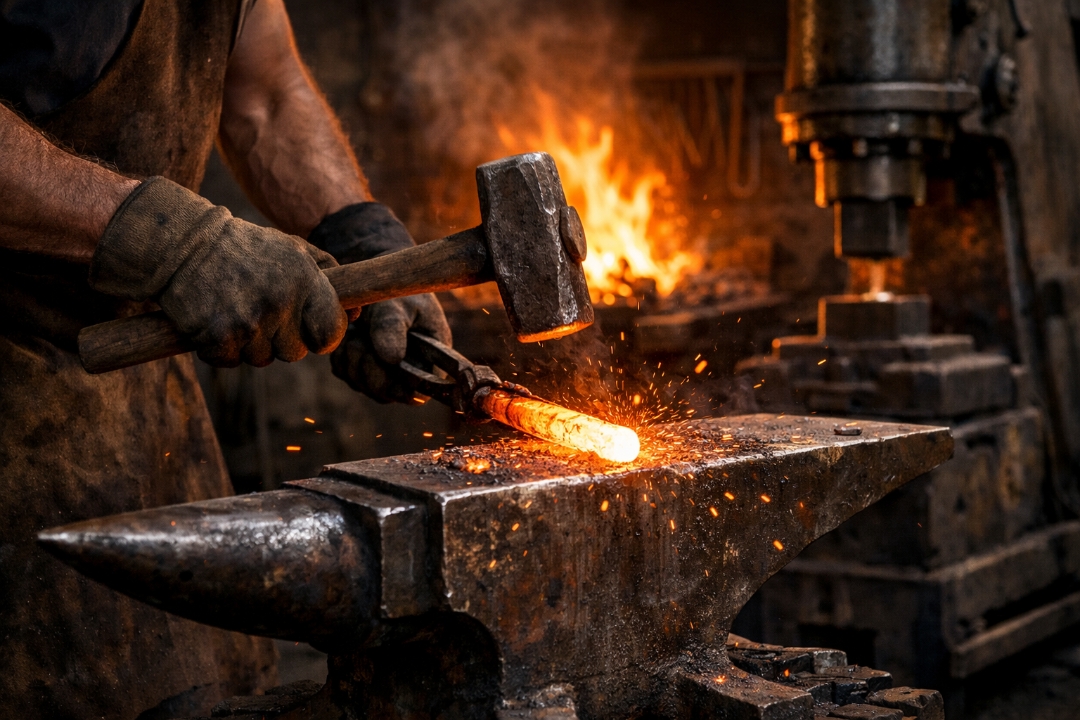

Introduction: From Fire and Hammer to Modern Precision Engineering
From tiny, intricate components in watchmaking and surgical instruments to the highly durable chassis of racing cars and the massive bearings used in wind turbines, there is a common defining factor: reliability. All of these products, without exception, go through a process called forging.
Forging is one of the oldest yet most advanced metal-forming processes, with roots in ancient civilizations. However, in today’s industrial world, it has evolved into a highly precise engineering science. In this process, metal—typically steel, aluminum, titanium, or nickel alloys—is shaped under controlled mechanical or hydraulic pressure and, in most cases, under the influence of heat.
The fundamental difference between forging and other manufacturing methods lies in the fact that, in forging, the metal is deformed in its solid state. This controlled plastic deformation not only changes the shape of the part but also significantly improves the internal structure (microstructure) and the mechanical properties of the metal. The result is components with higher density, greater tensile strength, and exceptional fatigue resistance.
But what distinguishes a high-quality forged component from one with structural defects? Why do some forged parts last several times longer while others fail prematurely? The answer lies in the details of the process: precise temperature control, deformation speed, and most importantly, friction management and lubrication. In this article, we will take a detailed look at the concept of forging and its technical challenges, and then provide a comprehensive roadmap for understanding and optimizing the forging process.
What Exactly Is Forging? Technical Definition and Scientific Principles
Forging is a process in which metal is shaped into a desired form through the application of uniform or impact compressive forces (such as hammering or pressing using hydraulic/mechanical presses), while remaining in the solid state—usually at elevated temperatures to reduce internal stresses.
Unlike casting, where metal is melted into a liquid state and poured into a mold (which can lead to microscopic porosity, gas bubbles, and irregular grain structures), forging deforms the metal while it remains solid (typically at high or warm temperatures).
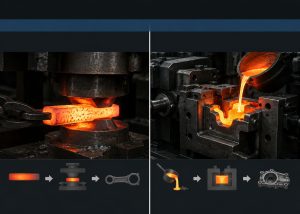
Forged components produced through the forging process exhibit several unique characteristics:
1. Grain flow continuity (Grain Flow):
The crystalline structure of the metal (grain structure) becomes aligned along the direction of the applied forces. This alignment leads to a significant increase in the component’s strength and its resistance to fracture and fatigue cracking.
2. High structural density and mechanical strength:
The compressive process eliminates any porosity or microscopic voids present in the original billet, increasing the part’s density to nearly the theoretical maximum of the metal.
3. Improved mechanical properties:
Due to grain refinement caused by plastic deformation, properties such as hardness, fatigue strength, and impact resistance are significantly enhanced.
Why is forging the first choice in critical industries?
In strategic industries such as aerospace, oil and gas, automotive manufacturing, and medical equipment, the failure of even a small component can lead to severe human and financial consequences. Engineers in these fields prioritize “reliability” and “intrinsic safety.” Forging, thanks to its controlled deformation of the metal structure, produces parts with significantly higher strength and no internal voids (which are common in casting). This means components that do not suddenly fail under extreme stress, fatigue, or impact.
In other words, forged parts have several distinctive characteristics, such as:
Fatigue resistance: Forged components can withstand millions of load cycles (such as crankshaft rotation or aircraft wing loading) without failure.
Uniform properties: Unlike casting, where physical properties may vary across different sections of the part, forging ensures consistent mechanical properties throughout the entire component.
Traceability and quality control compatibility: The forging process can easily comply with strict standards such as AS9100 (aerospace) and ISO 13485 (medical devices).
Scientific principles of forging
The fundamental principle of forging is based on plastic deformation. When pressure is applied to metal at an appropriate temperature (hot, warm, or cold forging conditions), the atomic layers within the metal slide over one another, altering its crystalline structure.
Unlike other manufacturing methods, forging directs the grain flow of the metal along the final shape of the part. This grain alignment allows the mechanical properties of the metal—such as strength and ductility—to be maximized in the direction of operational loads.
Types of forging methods: which one is right for your project?
The choice of forging method has a direct impact on overall cost, dimensional accuracy, and the final mechanical properties of the component. Generally, forging is divided into three main categories:
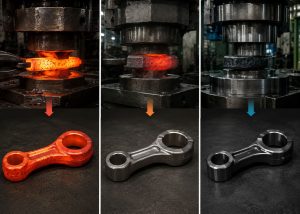
1. Hot Forging
This is the most common method used for mass production of large and heavy components.
Process:
The metal is heated above its recrystallization temperature (typically between 1000 and 1200°C for steel).
Advantages:
- Requires lower forming force (since the metal becomes softer at high temperature).
- Enables the production of parts with more complex geometries.
- Completely eliminates porosity and casting defects from the initial billet.
Disadvantages:
- Thermal contraction during cooling (requiring precise shrinkage allowances in die design).
- Surface oxidation (scale formation), which necessitates additional finishing operations.
- Strict temperature control is required to avoid overheating or grain burn.
2. Warm Forging
Process:
Forming is carried out at a temperature between room temperature and hot forging temperatures (generally below 70% of the melting point).
Advantages:
- Better dimensional accuracy compared to hot forging (reduced shrinkage).
- Improved surface finish with less oxidation.
- Higher strength compared to casting and close to hot-forged parts.
Application:
Suitable for medium-sized components that require higher precision, where cold forging would not be economically justified.
3. Cold Forging
Process:
Metal forming at room temperature.
Advantages:
- Excellent dimensional accuracy: minimal need for secondary machining (near-net-shape production).
- Work hardening: increased hardness and strength due to structural changes at room temperature.
- Superior surface finish: smooth and polished surface with little to no additional finishing required.
Disadvantages:
- Limited formability (mainly suitable for softer metals such as aluminum, copper, and mild steels).
- Requires extremely powerful and expensive press equipment.
- Restricted to small and medium-sized components.
Unique characteristics of forged components
When we talk about a forged component, what should we expect?
- Superior mechanical strength:
Due to the elimination of porosity and grain alignment, the tensile and yield strength of forged parts can be 20–50% higher than that of equivalent cast components. - High fatigue resistance:
This is the most critical property for moving parts. Forged components can withstand cyclic loading several times longer than cast or machined parts. - Continuous grain structure:
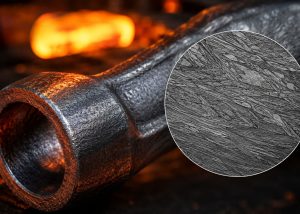
If a forged part is cut and examined under a microscope, the metal flow lines can be seen wrapping around the geometry of the component. This structure helps prevent crack propagation and significantly improves durability.
-
Uniformity throughout the entire component
Unlike processes that may create weak points at corners or edges, forging ensures complete structural integrity across the whole part.
Strategic advantages of forging in industrial production and metal forming
Why do leading industries accept the higher initial cost of forging?
Lightweighting and strength optimization:
Engineers can design components with reduced thickness while maintaining the same strength. This is critical in aerospace and automotive industries, where weight reduction directly improves fuel efficiency and overall performance.Material efficiency (reduced waste):
Compared to subtractive manufacturing (such as machining from a solid block), forging produces significantly less waste. In machining, 50–70% of a metal billet may be turned into chips, whereas in forging this figure is typically reduced to less than 5–10%.Material versatility:
Forging can be applied to a wide range of engineering alloys, including carbon and alloy steels, titanium, Inconel, and copper-based materials.Cost efficiency in mass production:
Although die design and tooling costs are high, the cost per part decreases significantly as production volume increases. For large-scale production (thousands to millions of parts), forging is unmatched in economic efficiency.Limitations of forging
Like other metal-forming methods, forging also has certain limitations:
- High equipment and tooling costs: Setting up a forging line requires substantial capital investment.
- Geometrical limitations: Unlike casting or 3D printing, producing internal cavities or highly complex shapes is difficult.
- High skill requirement: Precise control of temperature and pressure demands highly trained operators and engineers.
- Improper lubricant selection: One of the most common causes of metal sticking to the die and rapid tool degradation.
- Poor die design: Can lead to stress concentration points in the final part.
Common engineering mistakes in forging processes and how to address them
Many defects in forged components result from improper control of process parameters. Below are four common engineering mistakes in forging:
1. Inadequate temperature control
Problem:
If the temperature is too low, the metal becomes too rigid and may crack. If too high, grain coarsening occurs, reducing mechanical properties or even burning the metal.Solution:
Use precise furnace temperature control systems and continuously monitor billet temperature before press forming.2. Incorrect strain rate selection
Problem:
Excessively high forming speed can lead to improper metal flow and internal voids (pipe defects). Too slow a rate can cause premature cooling of the metal.Solution:
Optimize press or hammer speed based on the alloy type and component geometry.3. Poor die design
Problem:
Stress concentration points in the die, or insufficient consideration of flash and air evacuation, can lead to premature die failure and defects in the final part.Solution:
Use forging simulation software such as Deform or QForm before manufacturing physical dies.4. Use of inappropriate lubricants
Problem:
This is one of the most common causes of failure. Poor lubrication leads to metal sticking to the die, rapid tool wear, and surface defects.Solution:
Select specialized lubricants based on process temperature and alloy type.The critical role of industrial lubricants in forging: the hidden champions
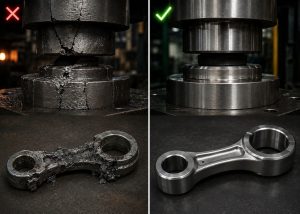
At first glance, lubricants may seem to serve only a simple “reducing friction” function. However, in high-temperature forging, they play multiple strategic roles. Without high-quality industrial lubricants, forging would be practically impossible or economically inefficient.
Lubricants in forging: the “hidden champion”
Lubricants play the role of a hidden hero in forging. Without them, the forging process would practically come to a halt. Their functions include:
1. Reducing friction between metal and die:
They allow the metal to flow more easily into all areas of the die cavity.
2. Preventing galling (adhesive wear):
They stop hot metal from sticking to the die surfaces.
3. Protecting the die from thermal shock:
Lubricants form an insulating layer that reduces the risk of cracking caused by sudden temperature changes.
4. Improving surface quality:
By creating a boundary layer, they produce a smoother, defect-free surface finish.
5. Facilitating part ejection:
They make it easier for the finished component to separate from the die.
Five key functions of forging lubricants
1. Reduced friction and improved material flow:
Lubricants create a protective layer between hot metal and the steel die. This minimizes friction and allows the metal to flow into complex die geometries. Without this layer, the required forming force would increase significantly, potentially leading to press failure.
2. Galling prevention:
At temperatures above 1000°C, metals tend to undergo adhesive bonding or “cold welding” with die surfaces. Graphite- or glass-based lubricants prevent this adhesion and protect the die from material transfer.
3. Thermal protection of the die:
Severe thermal shock—such as contact between 1100°C metal and a 20°C die—is one of the main causes of die failure. Lubricants act as a thermal barrier, reducing thermal cracking and extending die life by up to three times.
4. Improved surface finish:
A high-quality lubricant produces a smooth and uniform surface on the forged part, reducing the need for expensive finishing operations such as shot blasting or machining.
5. Easier part ejection:
After forming, hot components naturally tend to stick to the die. Lubricants ensure clean and damage-free separation from the tooling.
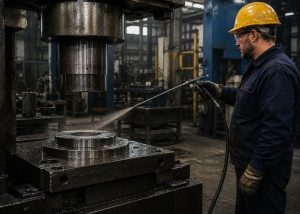
What defines an ideal forging lubricant?


No comment for this post.