
identification and analysis of defects in high pressure die casting hpdc
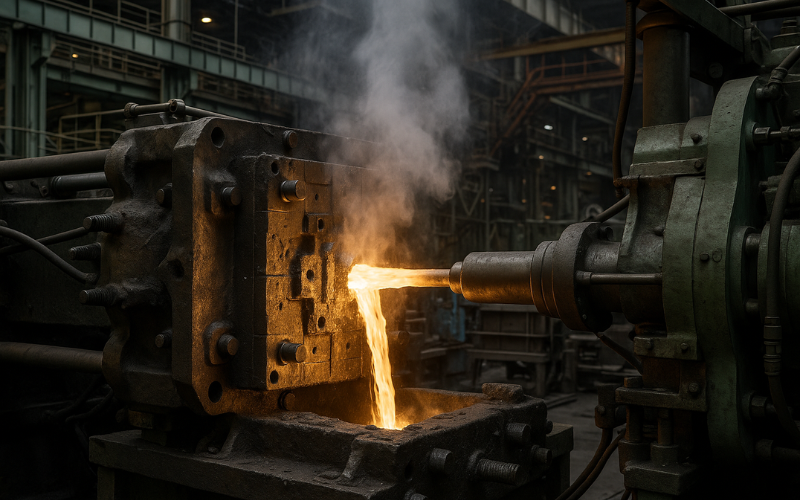

High Pressure Die Casting (HPDC) is one of the most important and fastest methods for producing metal components in the automotive, electrical, electronics, industrial equipment, and various engineering sectors.
In this process, molten metal is injected into a steel die at extremely high pressure, and the final shape of the part is formed within a few milliseconds.
Despite the many advantages of HPDC, this process—like any other complex industrial process—comes with challenges; one of the most significant is the formation of defects in the casting.
Defects in high pressure die casting can result from air entrapment, disturbances in melt flow, mold design errors, temperature-related issues, or unpredictable metallurgical behavior during solidification. Identifying these defects and analyzing their root causes enables production engineers to improve quality, reduce scrap, and optimize the process.
This article provides a comprehensive and engineering-focused overview of the most significant HPDC defects, based on the technical information referenced in the original document.
General Classification of Defects in HPDC
Overall, the defects in this process can be categorized into several major groups.
This classification helps engineers quickly determine the root cause of each problem:
1. Air Entrapment Defects
2. Flow-Related and Melt Behavior Defects
3. Temperature and Solidification Defects
4. Surface and Oxide Defects
5. Mechanical Defects and Cracking
6. Tooling- and Thermal-Related Mold Defects
Each category includes specific defect types, which are explained in detail below.
Air Entrapment Defects
One of the most common issues in HPDC is air entrapment.
When molten metal enters the die cavity at high speed and there is insufficient venting, air becomes trapped inside the melt, forming round, shiny, white pores.
These defects typically appear in the last areas of the part to be filled.
Main Causes:
-
Excessive injection speed
-
Poor mold venting
-
Improper runner and gate design
-
Lack of synchronization between injection phases
In the simulation section of the reference file, this defect is clearly visible through analysis of Air Pressure and Flow Front.
Flow-Related and Melt Behavior Defects
During the filling phase, molten metal may not flow uniformly.
Unstable or splashing flow can lead to several well-known HPDC defects.
Cold Shot
Small droplets of metal that solidify prematurely, appearing as small beads or particles on the surface.
Cold Junction (Cold Shut)
Occurs when two melt fronts meet at a low temperature and fail to fuse properly.
This results in weak bonding and visible cold-shut lines.
Lamination
A thin layer of metal becomes trapped between two other layers, without proper metallurgical bonding.
Main Causes:
-
Low melt temperature
-
Incorrect melt velocity
-
Poor design of flow paths
Surface and Oxide Defects
Oxidation of the melt inside the furnace or during transfer into the die is a major cause of surface defects.
Oxide skins become trapped inside the casting when the melt is contaminated or when the flow is highly turbulent.
These defects typically appear as dark, thin surface lines or patches and significantly reduce mechanical performance.
Temperature and Solidification Defects
The solidification phase plays a critical role in HPDC quality.
If solidification is not uniform and controlled, shrinkage and solidification-related porosity may occur.
Incomplete Cast (Short Shot)
Occurs when the melt does not have sufficient time to reach all parts of the cavity.
Sink Marks
Depressions formed in heavier or thicker sections where the metal solidifies more slowly.
Macro Shrinkage & Interdendritic Shrinkage
Large or micro-level shrinkage cavities caused by insufficient feeding during solidification.
In simulation results, these defects are identified through:
-
Hotspot analysis
-
Solid Fraction
-
Soltime (solidification time)
Stress-Related Defects and Cracking
Differences in cooling and solidification rate between various areas of the part can lead to residual stresses.
If these stresses exceed the material’s strength, cracks will form.
Two Main Types of Cracks:
Crack (Cold Crack or Hot Crack)
Cracks that appear during cooling or after part ejection.
Hot Tear
Occurs at the moment of solidification when the metal is still semi-solid and unable to resist tensile forces.
In simulation analysis, these defects are predicted through Stress and Strain Rate maps.
Mold-Related and Thermal Behavior Defects
Another major category of HPDC defects arises directly from the die and its thermal characteristics.
Erosion
Material removal from die surfaces caused by high-velocity metal jets or repeated high-pressure contact with molten metal.
This results in cavity damage, erosion marks, and edge deterioration.
Thermal Fatigue
Repeated thermal shock leads to a network of micro-cracks on the die surface.
These cracks eventually transfer onto the cast part.
These problems reduce both casting quality and overall die life.
Role of Simulation in Defect Prediction and Elimination
A key element in the reference document is the extensive use of simulation for defect prediction.
Modern simulation tools such as MAGMA, ProCAST, and AnyCasting can predict many defects before actual production.
Critical simulation outputs include:
-
Temperature Map
-
Air Pressure Map
-
Flow Front Tracking
-
Hotspot Distribution
-
Solidification Time (Soltime)
-
Stress and Strain Distribution
These data help engineers:
-
Identify the exact root cause of a defect
-
Improve mold design
-
Optimize injection pressure and speed
-
Re-design venting and air-exit paths
Final Summary
Defects in High Pressure Die Casting arise from the complex interaction of melt flow, temperature, pressure, mold design, melt quality, and thermal behavior.
Accurately identifying each defect—along with the use of simulation and technical analysis—can significantly improve casting quality and reduce scrap rates.




No comment for this post.